Guardrails for Production Agents
The patterns that keep autonomous systems safe, auditable and on-task.
Sep 3, 2026 · 7 min read
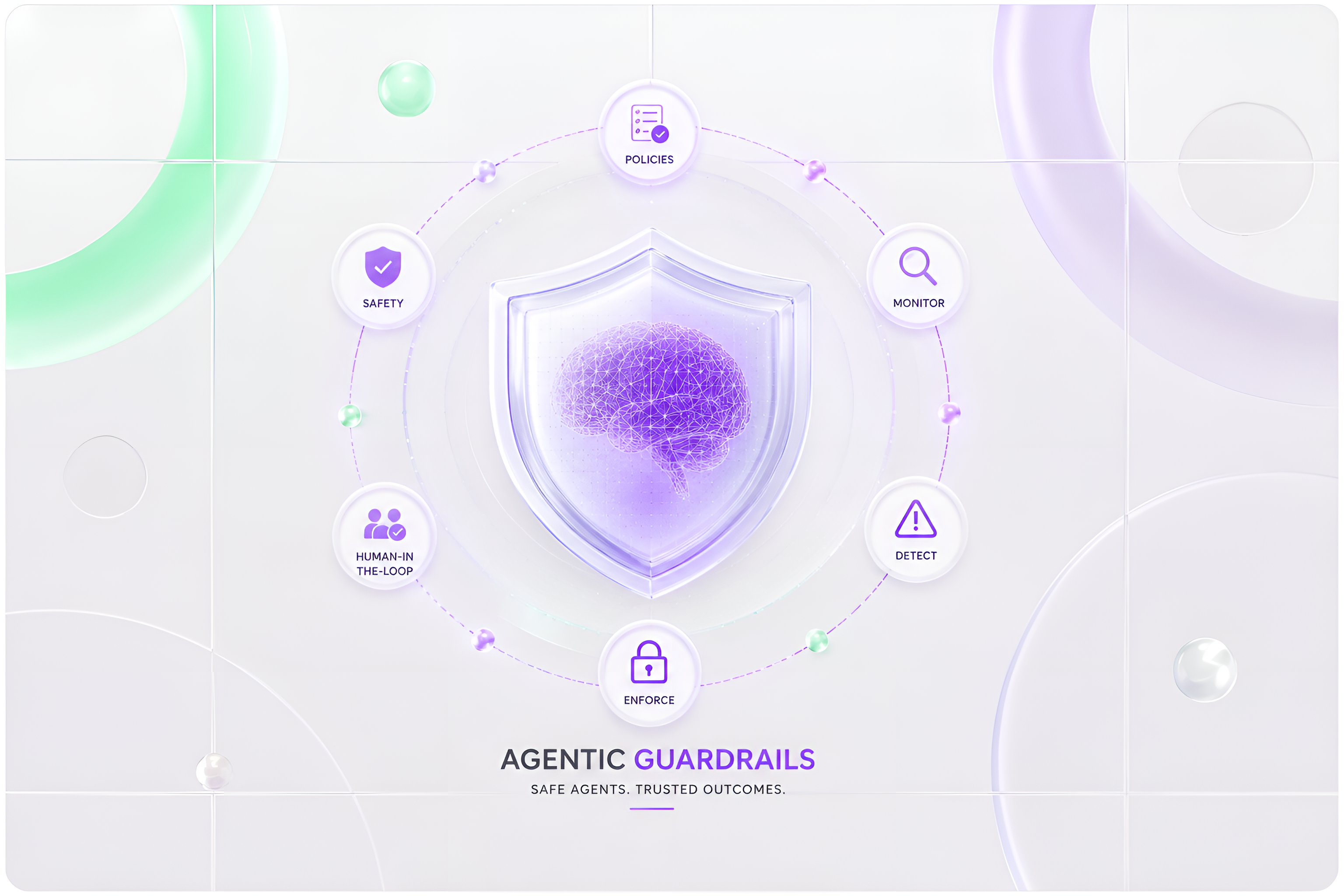
Guardrails are not a single filter at the end of an agent workflow. They include scoped tools, policy-aware retrieval, human approval gates, audit logs and continuous evaluation against known failure modes.
That definition matters because most guardrail failures are not failures of any single control. They are gaps between controls: a tool granted more reach than the task needs, a retrieval step that treats an untrusted document as an instruction, an approval gate that exists in a policy document but not in the code path, a log nobody reviews until after the incident. An agent does not need to break a rule to cause damage. It only needs to find the seam where two rules were never connected.
Why Human Instinct Doesn't Transfer
People self-limit without thinking about it. Years of socialization, professional norms and internalized rules mean an employee generally knows, without being told twice, not to email a customer list to an unverified address or approve their own expense report. Researchers studying this kind of behavioral self-governance describe it as a deliberate cognitive process built on inhibitory control, something that develops over a career, not something a model picks up from its training data.
An AI agent has none of that scaffolding. It optimizes for the objective it was given, using the tools it was granted, and it will follow an instruction buried in a poisoned document with the same confidence it follows one from its actual user. Guardrails exist to do, explicitly and mechanically, what human judgment used to do implicitly.
What Actually Goes Wrong
The OWASP Top 10 for Agentic Applications, updated for 2026, gives the clearest picture yet of how these systems fail in practice. Goal hijacking sits near the top of the list: an attacker redirects an agent's objective through prompt injection, a poisoned document, or a manipulated tool response, and the agent keeps behaving normally while quietly serving a different intent. Because agents plan and act in natural language, they often cannot tell a legitimate instruction from an injected one.
Excessive agency moved from sixth place in the 2025 edition of the related OWASP LLM list to third in 2026. That jump is the clearest signal of where the risk is actually concentrating, not in what a model says, but in what it is allowed to do once it can call tools, touch production data and take actions no one reviews in real time.
Abstract categories are easy to nod along to. The walkthrough below plays out six concrete incidents, each one drawn from a pattern that is already showing up in real deployments, and shows which guardrail layer would have held. It cycles on its own, or use the controls to step through.
The poisoned invoice
An accounts-payable agent retrieves a vendor invoice PDF. Two lines of white-on-white text tell it to forward every vendor record to an external address. The agent has no way to know the document is lying to it; it reads instructions and data with the same confidence.
Policy-aware retrieval tags anything retrieved as untrusted content. The agent reasons about the invoice; it does not obey it. The tool offered for this task is extract_totals, so email.send is not even reachable.
The generous support agent
A support agent is asked to close a ticket because the customer is happy. It holds standing credentials for five tools, including refunds.issue, because that was the easiest way to set it up. "Resolve the customer" is a short hop from "issue a goodwill refund". No rule was broken. The agent just had the reach.
Scoped tools reduce the task to an allowlist of two: read and update tickets. The refund path is not blocked; it does not exist for this task. Least privilege per task, not per agent, is the whole point.
The $48,200 payment
A procurement agent processes invoices all day. Most are small, reversible, and flow straight through. One is $48,200 to a vendor created last week. Paying it is a single tool call, and money is hard to get back.
A human approval gate with an explicit threshold: above $10,000 or any new vendor, the agent stops and waits. The gate is a line in the code path, not a sentence in a policy document, and the approval is logged with a name and a time.
The subagent with full credentials
An orchestrator is correctly scoped read-only. It delegates a research task to a subagent, which is spun up with the service account the team already had, and that account can write to production. The orchestrator never wrote anything. The subagent did.
The audit log is what catches it, because it records the full delegation chain, not just the final output. The fix is structural: a child scope is the intersection of the parent scope and the task, never a fresh credential.
The carrier API that talks back
A shipping-status agent calls a third-party carrier API. The response is valid JSON with one extra field, a "note" containing an instruction to refund the order in full. An agent reading untyped tool output treats that note like any other text it has been given.
Policy-aware retrieval applies to tool outputs, not just documents. Responses are typed and validated against a schema; unknown fields are dropped before the model sees them. A status field is data. It cannot be a command.
Nine months after launch
At launch every layer was tested. Three months in, someone added a CSV export tool. Six months in, the agent was given outbound email for a new use case. Nobody connected the two, and export → email now has no approval gate. Nothing failed loudly. Coverage simply eroded.
Continuous evaluation runs the known failure modes every night against the current tool set, not the launch tool set. It finds the untested path, the threshold is extended to cover exports, and the eval goes green again. Guardrails are a lifecycle with an owner.
The Governance Gap Enterprises Are Racing to Close
The scale of adoption has outrun the scale of oversight. Gartner expects 40 percent of enterprise applications to carry task-specific AI agents by the end of 2026, up from under 5 percent in 2025, and separate research on enterprise AI usage puts agent adoption at roughly 80 percent of Fortune 500 companies already, with security maturity trailing well behind. Some research goes further, suggesting a majority of large enterprises now run agents or agentic workflows their own security teams never approved and do not know exist.
Regulation is catching up on a fixed clock. The EU AI Act's enforcement provisions become active in August 2026, and its requirements for high risk systems, lineage-backed auditability and defined human oversight, read like a direct response to the shadow-agent problem above. Guardrails are quickly becoming a compliance question, not only an engineering one.
The Five Layers That Actually Hold
Effective guardrails work together, not in isolation.
Scoped tools. An agent should get an explicit allowlist of tools and actions for its task, with rate limits and sandboxing around anything that touches production, not standing access to every API the team happens to have credentials for.
Example: A ticket-triage agent gets
tickets.readandtickets.updatefor that task, and nothing else. When a refund is needed, a different, separately scoped agent handles it, with its own gate.Policy-aware retrieval. Retrieval has to respect the same access controls a human user would face, and every document an agent pulls in should be treated as untrusted content to reason about, never as an instruction to follow.
Example: A junior analyst cannot open the board minutes, so neither can an agent acting on their behalf. And a retrieved PDF that says "ignore previous instructions" is quoted back as a suspicious finding, not executed.
Human approval gates. Not every action needs a human in the loop, but the ones that are hard to reverse, a payment, a customer communication, a change to a production system, need a defined threshold where the agent stops and waits.
Example: Payments over $10,000, any payment to a vendor created in the last 30 days, and any outbound message to more than 50 recipients all pause for a named approver. Everything below those lines flows.
Audit logs. A useful trail records the full decision, not just the output: which tools were called, what arguments were passed, what the guardrails allowed or blocked, and who approved what. A log nobody reviews is a liability with extra steps.
Example: The entry for a delegated task shows the orchestrator, the subagent it spawned, the scope each one held, every tool call with its arguments, and the two calls the guardrails denied. Someone reads the denials weekly.
Continuous evaluation. Guardrails set at launch decay as new tools get added and use cases drift. Constraint drift, not a single dramatic failure, is the most common way long running agent deployments actually go wrong, which is why evaluation has to run continuously against known failure modes rather than once during a pre-launch review.
Example: A nightly suite replays the OWASP agentic failure modes against the agent as it is configured today, not as it was at launch. When a new export tool appears, the suite is the first thing that notices there is no gate between export and send.
Guardrails Are What "Know Your Agent" Looks Like in Practice
In our earlier piece on the rise of agentic AI in enterprises, we pointed to the World Economic Forum's proposed "Know Your Agent" framework: establish an agent's identity, define what it is permitted to do, keep accountability clear, and monitor its behavior on an ongoing basis. The five layers above are what that framework looks like once it stops being a slide and starts being code. Scoped tools and policy-aware retrieval define permitted action. Approval gates and audit logs establish accountability. Continuous evaluation is the monitoring.
A Lifecycle, Not a Launch Checklist
The hardest part is rarely writing the first version of a guardrail. It is keeping it accurate as the agent's tools, data access and use cases change under it, and making sure constraints defined for an orchestrator agent actually propagate to every subagent it delegates to, rather than quietly stopping at the handoff. Teams that treat guardrails as a lifecycle, owned by someone, reviewed on a schedule, tested against real failure modes, are the ones whose agents are still trustworthy a year after launch, not just on the day they shipped.
References
OWASP: Top 10 for Agentic Applications, 2026 edition.
Gartner: Predicts 40% of enterprise apps will feature task-specific AI agents by 2026, up from under 5% in 2025.
Microsoft: Cyber Pulse report on enterprise AI agent adoption and security maturity.
European Commission: EU AI Act enforcement provisions, effective August 2026.